



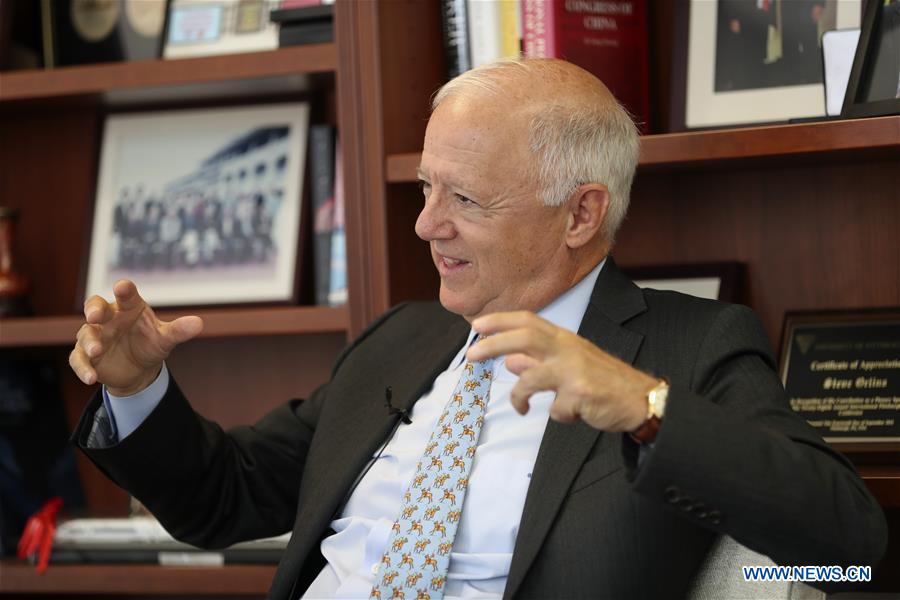
Stephen A. Orlins, president of the U.S. National Committee on U.S.-China Relations (NCUSCR), speaks during an interview with Xinhua at his office in New York City, the United States, April 14, 2017.(Xinhua/Wang Ying)
by Xinhua writer Yang Shilong
NEW YORK, Dec. 19 (Xinhua) -- "When historians of the future write the chronicles of our times, a highlight is sure to be China's remarkable 40 years of reform and opening-up. What an amazing transformation it has been!" Robert Lawrence Kuhn told Xinhua via email on Tuesday after receiving a medal in Beijing.
The 74-year-old chairman of the Kuhn Foundation was among the 10 foreigners honored with the China Reform Friendship Medal at a grand gathering celebrating the country's 40th anniversary of reform and opening-up.
This week when celebrations are in full swing in China, many senior American experts on China also recalled their personal experiences on China and the incredible changes they have witnessed.
CHINA SPEED
"Next year will be my 40th anniversary of setting foot in Beijing for the first time, and it was right after (late Chinese leader) Deng Xiaoping announced Gaige Kaifang (reform and opening-up)," Stephen A. Orlins, president of the U.S. National Committee on U.S.-China Relations (NCUSCR), told Xinhua in a recent interview.
"I would've never dreamed then China would develop the way it has, and what it would become," said Orlins, who was a member of the legal advisers' office at the U.S. Department of State and among the earliest to witness the establishment of the U.S.-China diplomatic relationship in 1979.
When Orlins first went to China, Chinese people had to buy food and other necessities by ration coupons, due to commodities shortage.
Recalling the poor Chinese friends who could have a good meal only when he invited them, Orlins said, "Now they picked me up in their BMWs at the airport, and this is in one lifetime that I've gotten to see this change."
"The people look different. They dress differently. They are healthier, they're bigger and they're better educated," he added.
In the view of Robert Hormats, vice chairman of consulting firm Kissinger Associates and also a close watcher of China, new and fresh things are happening in China all the time.
"I love going, and you cannot understand China unless you go there. You can read, but you have to go there and talk to people," said Hormats, who has visited China over 100 times.
Avery Goldstein, director of the Center for the Study of Contemporary China at the University of Pennsylvania, fell in love with China's high-speed rail.
"The high-speed rail in China is perfectly smooth,"Goldstein said. "It's almost always on time. I think it makes it easier for people to do business in China, and certainly makes it easier for me to go from city to city, and to work on the train."
INNOVATION KEY
"You see where China has come from and where it is today, and it's remarkable. It is one of the greatest stories of human history," Hormats said, adding that innovation is playing a key role in China's success story.
"China is doing well because it's very innovative and very hard-working, and very competitive," he said. "It is not a closed system, it is an open system ... Don't make the mistake of thinking China is not a dynamic internal economy, because it is."
David Reibstein, professor with the Wharton School of Business at the University of Pennsylvania, told Xinhua that he loves going to China because everybody that he runs into in China embraces change.
"My experience in other parts of the world and in the United States is that people are resistant to change," he said. "In China there is enthusiasm in embracing change, and that's great to see."
Reibstein inaugurated the Best Countries ranking in 2016 jointly with U.S. News & World Report. China was 20th in its 2017 ranking, and in the sub-ranking of the most innovative countries, China ranked fourth, only after Japan, South Korea and the United States.
Reibstein recalled that, during his early visits to China, people wore the same styled clothes and only one brand of shampoo could be found in shops. Reibstein first visited China in 1981 and has been visiting the country annually since 1997.
"I would go (to China) every year and see the changes just so dynamic, so exciting," he said.
China ranks 27th in the world's most competitive economies list, up from last year's 28th, according to the report released by the World Economic Forum (WEF) in September. China was at 46th when the WEF annual report was launched in 2004.
"China needs to maintain its momentum as an innovator. This is the point in the development cycle right now where China has hit the middle income threshold, call it 18,000 U.S. dollars per year per capita, where most developing economies struggle," said Stephen Roach, senior fellow at Yale University's Jackson Institute for Global Affairs, in a recent interview.
"The key to avoiding the middle income trap is to shift from importing technology and innovation of others to doing it yourself, indigenous innovation," said Roach, who is also the former chairman of Morgan Stanley Asia. "China is at that point right now... Those are largely being done by an impressive population of Chinese researchers, scientists and other entrepreneurs. They're having considerable success."
OWN PATH & GLOBAL STAGE
China has followed its own path of economic development and has become the largest and fastest-growing developing country, with its GDP averaging an annual growth of 9.5 percent in past four decades. Meanwhile it engages in international development more and more actively, making contributions to the world, experts say.
China's way of development, which is different from Western development, "can be very positive for the whole world," Shirley Young, chair of the U.S.-China Cultural Institute, to Xinhua.
Young served as corporate vice president of U.S. auto maker General Motors (GM) from 1988 to 1999, then as vice president for China Strategic Development and Asia Pacific Counselor, and had key involvement with GM's investment in China.
Young said she believes that China will continue to develop in a characteristic way, based on its own culture, history, geography, economic situation, way of thinking and the Chinese people's needs.
Forty years have passed, and China has transformed from "a backward economy and a closed society" to the world's second-largest economy, engaged openly with all countries and involved in all matters of global importance, Kuhn said.
With China "stepping up onto the stage for global governance," it is also making great contributions to global peace and development, Orlins said.
China's proposals for boosting global growth, like the Belt and Road Initiative (BRI) and the Asian Infrastructure Investment Bank, have demonstrated its role as a "responsible stakeholder" in the world, he said.
The BRI brings economic development to other places and is good for those regions, "which is good for China, good for America, and good for the rest of the world," Orlins added.
Moreover, these initiatives are "basically complementary to the existing world system," namely the World Bank, the Asian Development Bank and the World Trade Organization, among others, he noted.
MIRACLE TO CONTINUE
About 70 percent of respondents across 25 countries said China plays a more important global role than it did a decade ago, according to a new Pew Research Center survey released in October.
"China's role has dramatically increased, and China has an impact on everything that goes on virtually anywhere in the world," Hormats said.
Driving global growth for decades, China has become a major trading partner with over 130 countries. It is also the second-largest investor in UN peacekeeping operations, and has sent the most peacekeeping forces among the permanent members of the UN Security Council.
According to current UN standards, China has lifted more than 700 million people out of poverty and contributed over 70 percent to global poverty reduction.
"It's important that, regardless of U.S.-China relations, the Chinese government continues to implement the Gaige Kaifang," Orlins said. "I've witnessed this miracle, but I want the miracle to continue."
Roach agreed. "China, I think, will be the most dynamically growing domestic market in the world for the next 50 years," he said. "So other countries around the world can support their growth agendas by improving their presence in China."
(Video reporters: Zhang Mocheng, Yang Shilong, Zhang Yichi, Chang Yuan; Video editors: Liu Ruoshi, Geng Linlin)