China Focus: Computing power woven into hair-thin fibers, paving way for smart clothes, brain implants

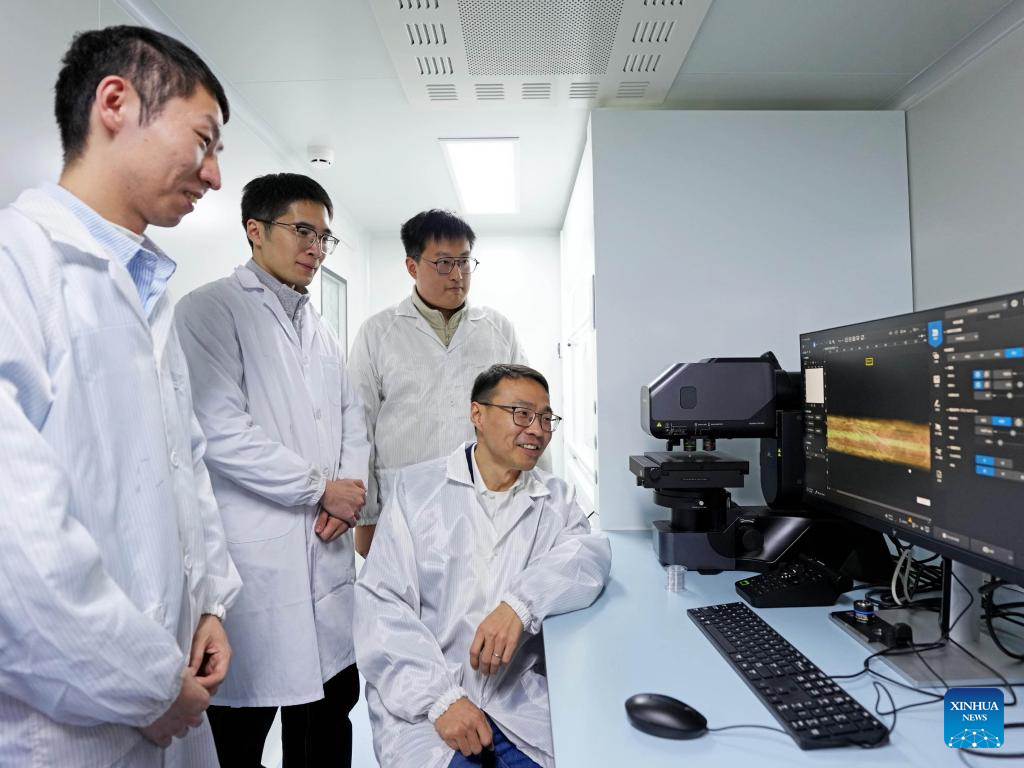
Researchers look at an enlarged image of a "fiber chip" on a computer screen at Fudan University in east China's Shanghai, Jan. 19, 2026. (Xinhua/Liu Ying)
SHANGHAI, Jan. 22 (Xinhua) -- Scientists in China have created a flexible, thread-like "fiber chip" that can be woven into fabric, opening the door to garments that function as interactive screens, advanced brain implants capable of processing signals internally and hyperrealistic virtual reality touch.
Researchers from Fudan University successfully integrated a functioning integrated circuit -- combining processing, memory and signal capabilities -- directly into a single, elastic polymer fiber thinner than a human hair.
The breakthrough, published in the journal Nature on Thursday, moves beyond the rigid, planar form of traditional silicon chips.
"The human body is made of soft tissue, so emerging fields like future brain-computer interfaces demand soft, compliant electronic systems," said Peng Huisheng, who led the study. His team has spent over a decade developing functional fibers for lighting, display and power.
However, the central challenge was constructing complex, stable micro-electronics on a soft, curved material that can stretch and twist, "akin to building a skyscraper on soft, bumpy mud and making it withstand deformation," explained Chen Peining, a corresponding author of the study.
SUSHI-ROLL INNOVATION
The team circumvented the limitations of fiber's tiny surface area by looking inward, drawing inspiration from "rolling sushi."
To solve the problem that ultra-precise integrated circuits cannot be patterned on rough, uneven surfaces, they created an ultra-smooth, nanometer-flat surface on a stretchable elastomer, turning a "rugged mountain range" into a "glass-smooth plain."
Then, the researchers fabricated high-precision circuits on this sheet using standard lithography manufacturing processes, and protected them with a dense coating to resist chemical solvents. Finally, they rolled this film into a tight, multi-layered spiral within the fiber itself.
This architecture allows for a remarkable integration of transistors, resistors and capacitors, according to the study.
Lab tests have shown that the resulting fiber circuit could withstand repeated bending and abrasion for 10,000 cycles, and even being crushed by a 15.6-tonne truck. Crucially, it packs 100,000 transistors into every centimeter, so a single one-meter fiber hosts as many transistors as a classic computer's CPU.
In a demonstration, the fiber chips are shown to be capable of processing digital and analogue signals and performing neural computing tasks for image recognition with high accuracy. "The fabrication is fully compatible with today's lithography lines, so it can plug straight into high-volume manufacturing," Chen said.
GAME-CHANGER
The implications of the innovation span multiple frontier industries.
In brain-computer interfaces, today's rigid neural probes must connect to external processors. The soft, biocompatible fiber chip might be implanted to detect, pre-process and even provide feedback for neural signals within the body, reducing infection risk and improving compatibility with brain tissue.
A 1,024-channel-per-centimeter electrode array, together with on-board circuitry, can be integrated on ultra-thin fibers as slender as 50 micrometers in diameter, which match brain tissue in softness and can record neural signals whose signal-to-noise ratio rivals that of commercial devices, according to the study.
In consumer electronics, the same technology could be harnessed to create futuristic smart wearables.
"For electronic textiles, past fabric displays could only show simple static patterns. To achieve dynamic video or touch interaction, an information-processing module is indispensable," said Chen Ke, a co-first author of the study.
Clothing integrated with these fibers could display navigation, health data or videos directly on the sleeve.
In virtual and augmented reality, gloves woven with sensor-laden fiber chips could provide precise, distributed tactile feedback. "A surgeon wearing them for remote surgery could clearly perceive the hardness of organs while a game player could realistically feel virtual props," said Wang Zhen, another co-first author.
At present, the team is already collaborating with a hospital to explore use in cardiovascular surgery.
"We hope that one day electronic fabrics built on 'fiber chips' will exchange information as efficiently as today's phones and computers," Chen Peining said. ■
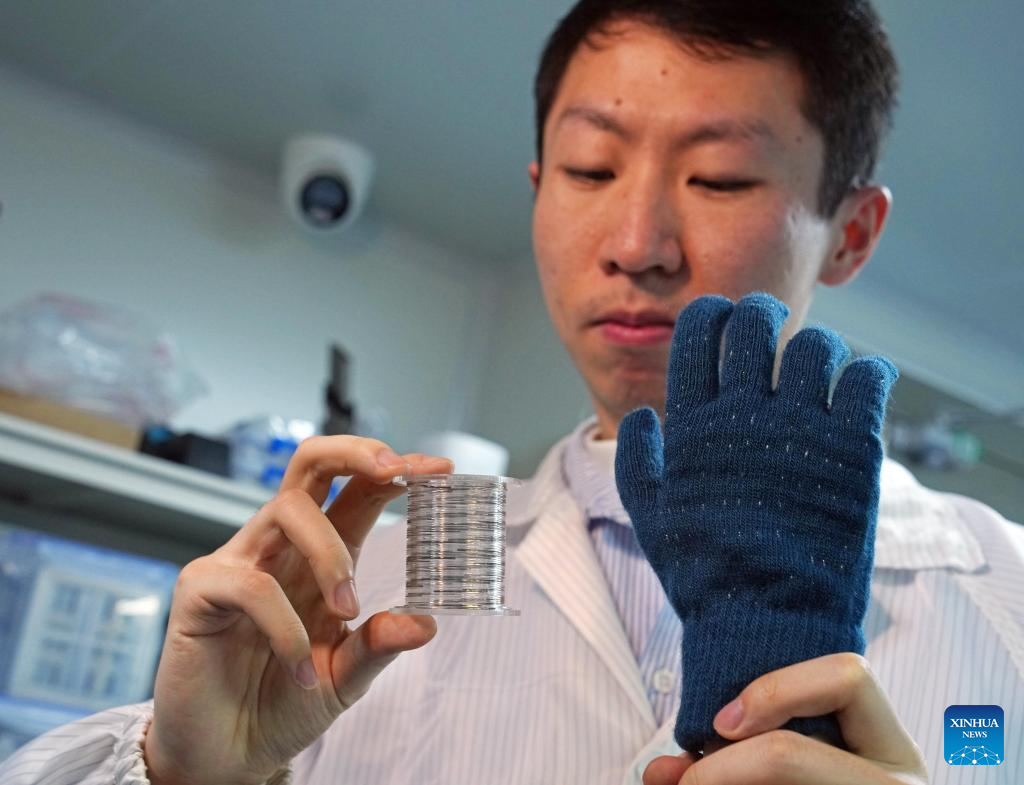
A researcher displays rolled-up "fiber chips" and a smart tactile glove made by weaving the chips into textiles at Fudan University in east China's Shanghai, Jan. 19, 2026. (Xinhua/Liu Ying)
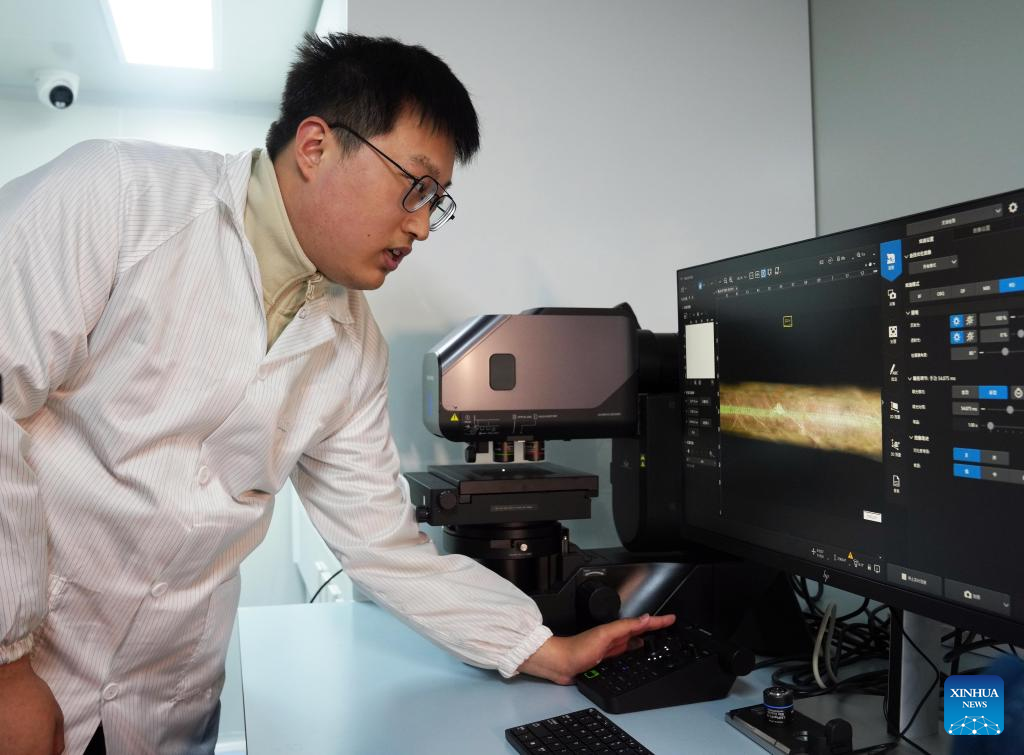
A researcher displays an enlarged image of a "fiber chip" on a computer screen at Fudan University in east China's Shanghai, Jan. 19, 2026. (Xinhua/Liu Ying)
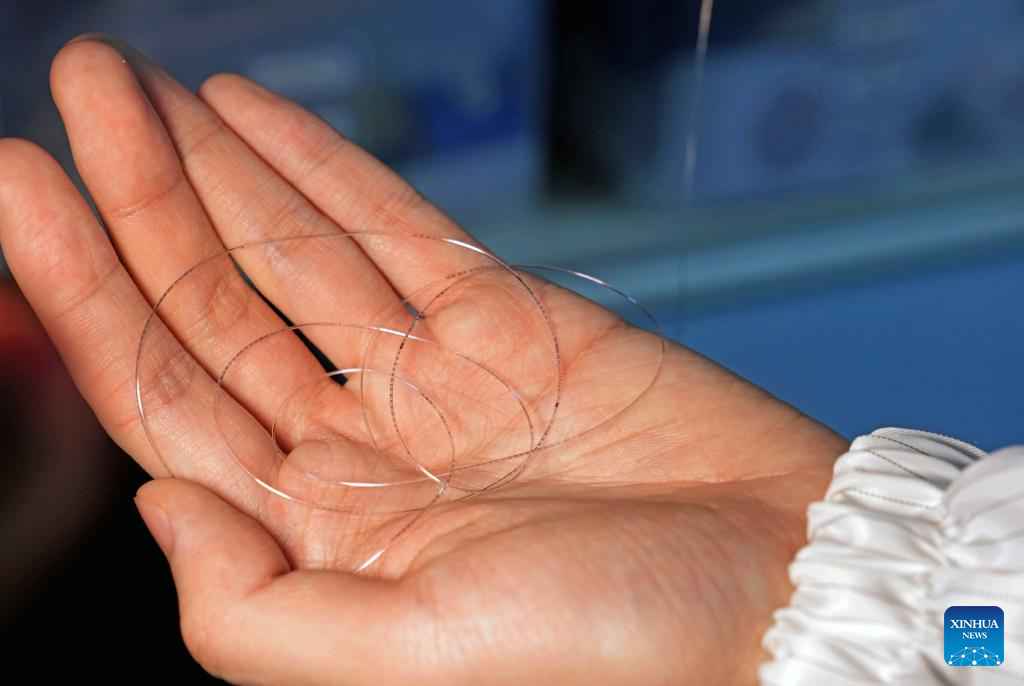
This photo taken on Jan. 19, 2026 shows a "fiber chip" at Fudan University in east China's Shanghai. (Xinhua/Liu Ying)


