Across China: Between paper and pixels, a library repairs what time wears down

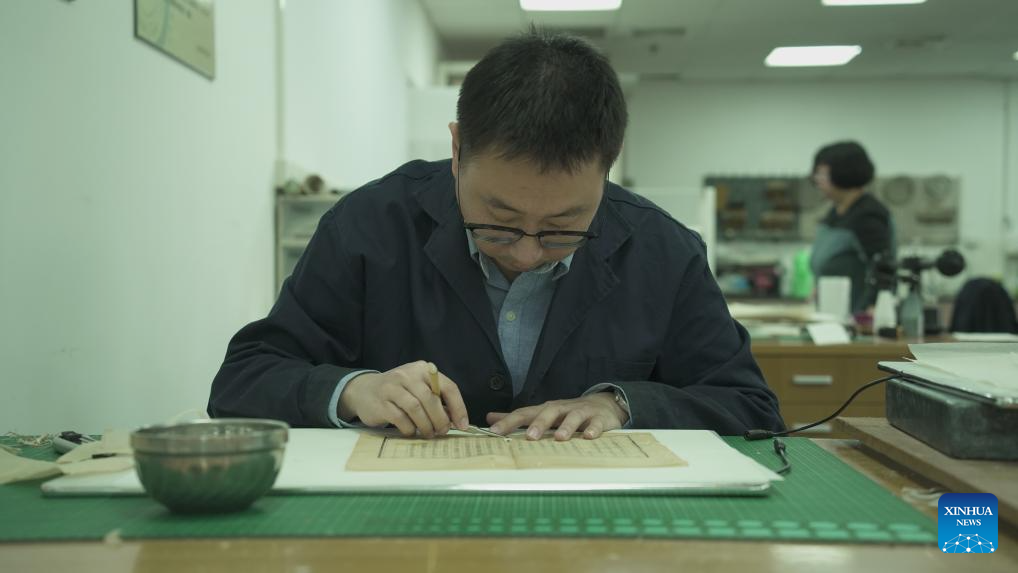
Wang Hongjie works in a restoration room at Tianjin Library in northern China's Tianjin, on Dec. 10, 2025. (Xinhua/Bao Qingling)
TIANJIN, Jan. 28 (Xinhua) - In a restoration room at Tianjin Library in northern China's Tianjin Municipality, Wang Hongjie steadies the paper with his fingertips and wets the frayed edges of the damaged areas with a goat hair brush that he has dipped into wheat-starch paste.
The hole he is mending -- covered with a thin sheet of paper -- is no larger than a grain of rice, yet it is big enough to disrupt reading the entire page.
He presses the patch into place, flicks away the excess material with tweezers, and lifts his hand.
The page looks whole again -- not new, but convincingly old.
This restorative work complements an ongoing large-scale digitization drive that is improving access to China's vast historic paper artifacts, while ensuring the longevity of their original forms.
Carrying a faint scent of aged paper, the library's ancient book restoration studio is tucked away at the end of a long corridor, beyond the reading rooms and into a dim recess. Here, Wang's meticulous work unfolds in near silence, defined by careful restraint rather than speed -- reflecting the care and patience required to preserve materials that have survived for centuries.
"Restoration follows the principle of 'repairing the old to retain its antiquity,'" Wang says.
The aim, he explains, is not to erase the signs of age, but to preserve what restorers call a book's "old aura." This aura resides in yellowed pages and torn edges, as well as in earlier bindings, handwritten notes and even traces of past repairs -- layers of use that quietly record the eras the book has witnessed.
Wang joined the Tianjin Library fresh out of university in 2012, the same year the library's Cultural Center opened and expanded its ancient book preservation facilities to about 1,000 square meters. By then, the institution already had over a century of restoration history.
Its predecessor, Zhili Library, was established in 1908. Early book donations were accompanied by skilled repairmen, who formed the library's first restoration team.
Over the past three months, Wang has focused on completing work on Huang Wenxian's family division deed, a hand-copied document from the mid-Ming Dynasty (1368-1644).
Restoring it required more than just patching holes. Wang noticed that different sections of the book -- the margins, corners, spine and fore edge -- had aged into subtly different hues. To avoid a visually jarring effect, he tinted papers that needed repair with black tea, traditional Chinese pigments and ink. After repeated adjustments, the repaired sections blended seamlessly into the original page.
Such details may seem minor to some, but for restorers like Wang, they determine whether a book can continue to "speak in its own voice."
Preserving that voice, however, is only part of the task. More importantly, for Wang and his colleagues, extending the book's lifespan is the greater priority. According to Ye Xuhong, another restorer at the library, acidification and fiber deterioration will only accelerate if left untreated. Proper restoration can halt this process and, under ideal conditions, allow a page to endure for centuries, perhaps even a millennium, he says.
"Ancient books embody the spiritual life of past generations," says Liu Yunfeng, a professor at the School of Information and Communication at Nankai University. "They carry the weight of cultural inheritance and, ultimately, the continuity of civilization."
Even a millennium, long for paper, is brief compared with the scale of a civilization's duration. At another branch of Tianjin Library, preservation has taken on a different form.
Here, Yang Xinyan leads the library's ancient book digitization team. Born in the 1990s, it is her third year working with digital texts. The initiative itself began in 2007, when China's State Council issued guidelines calling for stronger protection of ancient books, including large-scale digitization. Tianjin Library was among the first public libraries to respond.
Of the library's more than 580,000 ancient books, Yang says, about 100,000 have now been digitized, with nearly 59,000 freely accessible to the public.
This shift has reshaped access to historical texts. Wang Zhenliang, a professor at Tianjin Normal University, has used the library since the 1990s. He recalls that finding a single book once meant traveling to another city. "Now you can read it in 10 minutes," he says. The change, he adds, has greatly facilitated academic research and allowed many texts to circulate far more widely.
Policy support for these efforts continues to grow. At a conference on digital applications for ancient books, convened by the National Center for Preservation and Conservation of Ancient Books on Dec. 30, last year, Chen Ying, deputy director of the National Library of China, described ancient texts as "the genetic code of Chinese civilization." He added that the application of intelligent technologies would be key to understanding them in the future.
Yang is witnessing the transition already under way. Digitization, she says, is moving beyond the simple assembly of images. By applying big-data models to textual analysis, future systems could help readers navigate and utilize ancient books more effectively.
The community behind the work has expanded as well. When China's ancient book protection program began in 2007, fewer than 100 restorers were active nationwide. Today, there are over 1,000, supported by 33 national-level restoration centers and 51 training workshops, drawing participation from libraries, universities, museums and archives across the country.
The work remains slow, cumulative and largely unseen, but the efforts of countless fingertips continue to converge into something enduring.
Once, a millennium marked the outer limit of paper's survival. In an era shaped by digitization and intelligent technologies, the cultural legacy carried by these pages may travel further still, revived each time a book is read, studied or discussed. ■


