BEIJING, April 13 (Xinhua) -- In the sci-fi film, Gravity, U.S. astronaut Ryan Stone returns to Earth with the aid of a Chinese space station and capsule after the mid-orbit destruction of her space shuttle.
In reality though, space cooperation between China and NASA has been hampered by an exclusionary law passed by the U.S. Congress in 2011. Now the White House is rubbing salt into the wound by proposing tariffs on 50 billion dollars of high-tech imports from China covering the aerospace, information and communication technology, robotics, machinery and other sectors.
These are the emerging industries highlighted in the Made in China 2025 plan, which aims to strengthen the country's high-end industrial development and contribute to its ongoing economic transformation.
It is believed that a major motive behind the aggressive U.S. trade moves is to obstruct China's science and technology innovation, a key drive for its further development.
But if the U.S. side looks back on what it has done to stall China's space program, they may find it both useless and self-defeating to treat China with hostility.
Due to ideological divergences, China has long been shut out of the International Space Station, which is led by the United States and operated by a 15-nation partnership. This has forced China to develop its own space station.
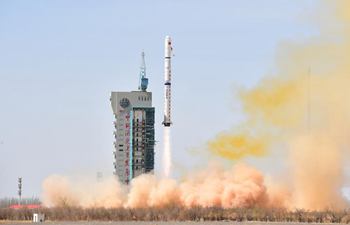
China has now launched two space labs into orbit. Tiangong-2, the second, accommodated two astronauts for 30 days, and hosted a series of cutting-edge scientific experiments, such as quantum key distribution, a cold atomic clock and gamma ray burst observation.
Tianzhou-1, China's first cargo spacecraft, docked with Tiangong-2 to test in-orbit refueling, another crucial technology for building the space station.
"Only China and Russia are now capable of in-orbit refueling," said Bai Mingsheng, chief designer of the cargo ship.
The next step is to assemble and operate a permanent manned space station. With the International Space Station set to retire in 2024, the Chinese station will offer a promising alternative, and China is then likely to be the only country with a permanent space station.
Though China has been toiling alone, it has reiterated many times that it will open its space station to scientists from around the world after it is completed, and welcomes international cooperation.
The ban by the U.S. Congress, which would bury a great deal of bilateral cooperation opportunities if it continues, has aroused protests from scientists and astronomers in the United States too.
Charles Bolden, former administrator of NASA, once urged his country to cooperate with China in space. Otherwise, he warned, the U.S. would be left out of new ventures to send people beyond the International Space Station.
He is right, as China has kicked off a full range of space science programs, including the three-step Chang'e lunar program: orbiting, landing and returning with samples.
"We propose to create an open platform for cooperation, sharing both risks and achievements, in lunar explorations," said Liu Jizhong, director of the China Lunar Exploration and Space Engineering Center of the China National Space Administration. The European Space Agency welcomed his announcement, as it echoed its own international moon village plan.
The U.S. denial of space cooperation has pushed China to seek closer partnerships with European countries.
The Chang'e-4 probe, expected to be launched this year, will be the first to land on the far side of the moon and it will carry scientific payloads developed by the Netherlands, Sweden, Germany and Saudi Arabia. China will also send an ocean-observing satellite jointly developed with France into orbit in September this year.
China's space program might serve as a lesson in how U.S. restrictions and bans cannot prevent China from advancing its major technologies.
Just like space exploration as a common human cause, science and technological research to expand the frontiers of human knowledge also requires cooperation due to its uncertainty and complexity, and should not be hampered by political concerns.
It's foreseeable that China's high-tech industries won't be foiled by the tariff threat. So is the United States really ready to give up all the cooperation opportunities in these sectors?