YINCHUAN, July 30 (Xinhua) -- The aerial view of the Baotou-Lanzhou Railway through the desert represents mankind's efforts against the forces of nature: moving sand dunes tamed by vast stretches of man-made straw structures, a technique originating from Ningxia, now known around the world.
The Baotou-Lanzhou Railway, which began operating in 1958, is an artery linking northern China to northwestern regions. It starts from Baotou in Inner Mongolia Autonomous Region and stretches to Lanzhou, capital of Gansu Province. The 990 km-rail link passes through the Tengger Desert in the city of Zhongwei in Ningxia Hui Autonomous Region six times.
The railway also runs through Shapotou, whose name means high-rise dunes. The region has 16 km of moving dunes, reaching up to 100 meters high.
"To ensure the successful operation of the railway, the desert needed to be tamed," said Zhang Zhishan, deputy director of Shapotou Desert Research and Experiment Station, Chinese Academy of Sciences.
August 1st marks the 60th anniversary of the opening of the Baotou-Lanzhou railway.
TAMING THE DESERT
Every day, 11 sets of passenger trains and 36 sets of cargo trains run along the Baotou-Lanzhou Railway. Protected by seedlings, grass hedges and trees, carriages tear through the southern edge of the Tengger Desert with ease.
"Before 1949, the desert was only 200 meters from Zhongwei. Experts from the Soviet Union, invited to design the railway, predicted that the railway would be buried by sand in 30 years," said Gao Yonggui, deputy head of Zhongwei Gusha (Dune-Fixing) Forestry Farm.
Sandy weather used to hit Shapotou 300 days out of the year. The year after the railway went into operation, sand buried the rails and suspended operations 11 times, he said.
In 1955, the Chinese Academy of Sciences established its first observation station in Shapotou. The next year, China's first forestry station in the desert was founded in Zhongwei. To address the issues the sand was causing, workers and researchers began relentlessly experimenting with desert control techniques.
Straw structures, which resemble checkerboards, remain the most convenient, environmentally-friendly and cheapest way of stopping sand encroachment. In Zhongwei, farmers make the straw checkerboards almost every day. Women place the straw on top of the sand, and men use a shovel to partially bury it in the sand, creating a checkerboard pattern spaced one meter apart. Each piece of straw is 10 centimeters below ground and 30 centimeters above ground.
Within the checkerboards, the surface of the sand forms a hard crust over time which prevents the sand from moving. Gao said this crust could last for more than 30 years.
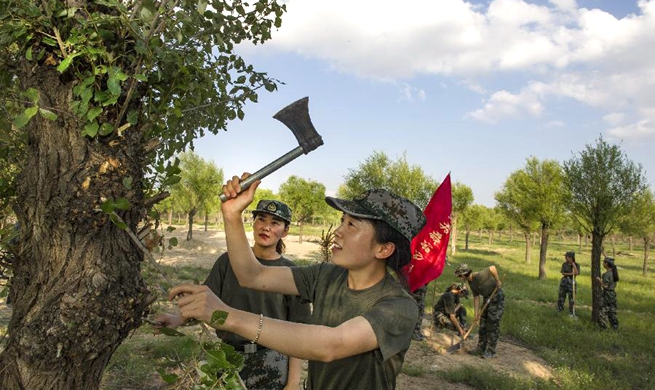
In Heilin village near Shapotou, around 200 people make a living by working in the desert to make the straw checkerboards. Some work near their homes, while others travel to work in desert areas in Inner Mongolia, Xinjiang and Shaanxi.
In Zhongwei, about 10,333 hectares of sand is covered by these straw checkerboards. Shrubs, windshield belts, and grass belts are also constructed to keep the railway safe. Water from the Yellow River was diverted to irrigate the plants and shrubbery. The fight against sand never stops in Zhongwei.
Sand has been kept away from the rails since the 1990s, locals said.
SHARING EXPERIENCE
"It is from Shapotou that China's experience of fighting against desertification began to be known by the world," said Zhang Zhishan.
In 1977, China shared the anti-desertification technique used in Shapotou at the UN Conference on Desertification in Nairobi, and in 1994, the Zhongwei forestry farm was elected to the UN Environment Program's Global 500 Roll of Honor for its achievements in sand control.
Desert control experts in Zhongwei are often invited by other countries to share their experience, said Zhang.
"In 2016, I went to the United States for a meeting on desertification control. They talked about straw checkerboards from China. I was very proud," he said.
Shapotou's improved environment has made the city a popular desert tourism destination, receiving over 1.3 million tourists last year.
Though the sand has been curbed, the threat is not gone. China has 2.61 million square km of desert, about 27.2 percent of the landmass. According to a regulation to advance ecological progress in 2015, half of China's sandy land will need to undergo treatment by 2020.
"If we do not move forward, we will fall back. It is a fight against nature," said Gao.
At the Shapotou station, researchers have established models to monitor precipitation, underground water levels, evaporation, and growth of plants in sandy land. The findings will be applied to refine management of plantation in deserts.
"Desertification control is arduous work. It requires stamina and generations of hard work," Gao said.