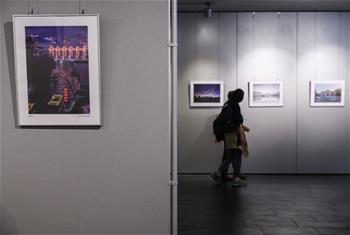
XINING, May 18 (Xinhua) -- From gold and silverware dating back to the Tibetan Tubo Kingdom (about 618-842) to thangka paintings, and various garments and accessories in different eras, visitors can learn every aspect of Tibet and Tibetans in the Qinghai Tibetan Culture Museum.
The Qinghai Tibetan Culture Museum, located in the city of Xining, capital of northwest China's Qinghai Province, houses a vast collection related to the ancient Tibetan culture.
Its collection of more than 50,000 works include Tibetan medicine, literature, calligraphy, folk culture and art, and astrology. Many of them are national-level cultural relics.
"Goldware in the Tubo period was known for its exquisite and unique craftsmanship, which was considered a miracle in the Middle Ages," said Dorje Drolma, a commentator of the museum, who tells visitors the history of each piece of the collection.
Dorje Drolma told visitors that diverse patterns on the gold and silverware reflected cultural exchanges and the integration between people living in Tibet and other regions.
A set of 2,000-year-old Tibetan medical surgical instruments, in which Dorje Drolma takes great pride, showed the fineness and maturity of the ancient Tibetan medicine.
"I know that Thangtong Gyalpo was a great architect of the Ming Dynasty (1368-1644) and one of the founders of Tibetan opera," said a visitor, adding that he learned the architect was also proficient in Tibetan medicine after saw exhibits including Thangtong's surgical instruments and prescriptions he wrote down in the museum.
"Visitors can learn the precious Tibetan culture and the ancient history of the Qinghai-Tibet Plateau through 'historical fragments' that we display in the museum," said Ngo Tsochen, the museum's curator.
Statistics showed that the museum has received more than 5 million visitors from home and abroad since it opened in 2006. Around 350,000 visitors came to the museum last year, with foreign tourists, students and residents living in the rural and pastoral areas accounting for a large proportion.
Private museums in the vast Tibetan areas have also played an important role in protecting and inheriting Tibetan culture.
Karma Chusang sorts out scriptures of the Tibetan Tripitaka, a treasured collection that records the words and deeds of Shakyamuni, the founding father of Buddhism, every day in the Dongtsang Tripitaka Museum in the Tibetan Autonomous Prefecture of Yushu in Qinghai.
The Tripitaka is the earliest collection of Buddhist writings. The information contained in the writings was originally passed down orally and was finally written down in the third century B.C.
The version of Tripitaka preserved by Karma Chusang's family has a history of at least 1,000 years.
The establishment of a Tripitaka museum helped better preserve the Tibetan Tripitaka, Karma Chusang said.
The local government has organized experts to upgrade the fire protection system of the museum and taught Karma Chusang's family members how to deal with mildew, wrinkles, and damages caused by worms on the scriptures.
"The museum is the glory of Tibetan culture, as well as the glory of my family," he said.
Phuntsog Dawa, chairman of the federation of literary and art circles of Yushu, said museums have played a crucial part in spreading Chinese culture and enhancing the soft power of China.
Taking the Qinghai Tibetan Culture Museum as an example, the museum has not only welcomed visitors from across the world but also organized overseas exhibitions in the Republic of Korea, Japan, and other countries, sharing Tibetan culture with more people around the world.
Meanwhile, the museum has developed multi-language services and introduced virtual reality (VR) technologies to attract more Internet and mobile phone users.
The museum has also created more than 200 kinds of cultural and creative products featuring Tibetan culture, including incense, bookmarks, mouse pads, Tibetan table mats and books.
"Tibetan culture is an important part of the Chinese culture and a treasure of the world culture. We try to bring Tibetan culture into people's lives through products with Tibetan culture and elements," Liu Shimin, director of the museum department of the provincial cultural relics bureau.